

Led Video Wall: Size Calculation Tips
If you are looking to procure an LED video wall for an event, a store lobby, or a permanent installation at a public venue, one of the first questions you may have is about the video wall size. Of course, you probably do not want to just select the largest wall available. Determining the right size involves a combination of scientific and artistic skills. It will influence everything from the budget to the effectiveness of your message. The following are some tips to guide you in determining the size of your setup.
Consider Your Audience First
Most important is not the wall, but the people who will be looking at it. Where will they be standing or sitting? The screen's distance to your audience, or viewing distance, is the leading factor. You want to ensure the audience will not have to strain their eyes to see the content. For instance, if you are mounting a screen in a TV Studio, like the Turkey project that used an E1.875 model, people and cameras will be right up close. You want a screen that is sharp for viewing from close range. Conversely, if you are constructing something huge for a public plaza, like the incredible naked-eye 3D display in Japan's Shibuya Plaza, people will watch it from a great distance. The viewing distance is a lot so the screen can, and needs to be, really big.
Consider Pixel Pitch in Relation to Size
One of the most important specifications to keep in mind is pixel pitch. You will see numbers such as 1.5mm, 1.8mm, or 10mm as part of these specifications. Pixel pitch is the measurement of the distance between the centers of two adjacent pixels. A smaller pixel pitch means more pixels, or more detail, which is best for close up viewing. On the other hand, if the pixel pitch is large, the pixels will be spaced further apart, which is best for large screens that will be viewed from a distance. How does this relate to dimensions? The distance from which the audience will be viewing the screen will determine the pixel pitch, which in turn determines how many modules you will need to construct a screen of that particular dimension. For example, the first screen displayed at the Academy Awards had an X1.5 screen. Although the screen was just 11 square meters, the 1.5mm pixel pitch provided detail that was important due to the close viewing distance of the cameras in the audience.
Calculate Based on Your Venue's Layout
It's time to get out your calculator, but first, get a copy of your venue's floor plan so you can measure the area. Find the maximum distance from the screen to the farthest viewer. What about the closest viewer? Knowing the range of the viewers gives you a good idea of where to set the screen. A good rule of thumb to go by for minimum screen size is the distance to the farthest viewer, but you also have to consider how big the screen is going to be. Think about the space too, How wide is the stage or wall area where the screen is going to go? How high is the ceiling? Make sure the screen is not going to be blocked by pillars or be too small for the area. The design of the LED video wall has to be for the maximum number of seats to be able to see the screen. This is about creating a great experience for everyone.
Think in Modules, Not Inches
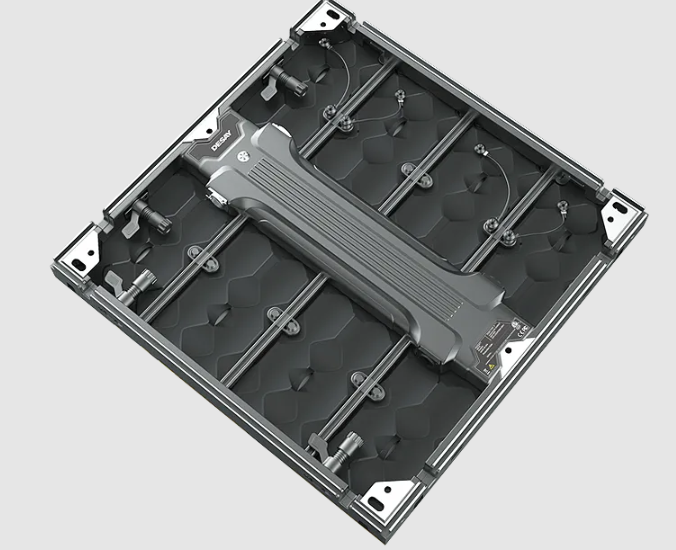
Instead of thinking of the video wall you will be getting as one large screen, think of it as many small video panels put together in a modular format. Because of this modular format, you will be able to put together a screen of almost any size and shape, as long as it fits within the dimensions of the format you choose. For the Shibuya project, they didn't just build one large rectangle. They built a complex and large visual presentation in a combination of multiple sections of 420 sq. m., 162 sq. m. and 90 sq. m. sections. So when you are thinking of what size you want, you have to think in terms of how many modules wide and how many modules tall you want it to be. The manufacturer will give you the dimensions of one module, and from there you can calculate the total size. This is also a place you can begin to think about the shape of your screen, whether you want it to be wide, tall, or of a more square aspect ratio.
Consider Your Content and Purpose
Screen size depends on your content and what you will be showing. For example, if the main activity on the screen is showing a live feed of a speaker or a band on stage, a large wide screen will work great as it will help capture the action. However, if you want the audience to have an immersive experience with a backdrop, perhaps even creating an alternate reality, you want them to have a screen that is large enough to fill most of their field of view. For groundbreaking ideas, like creating a display that is viewable in 3D without special glasses, the size of the screen is key to creating an impressive effect. If the screen is too small, it will not dominate the space. Your goals will determine the screen size needed for your purpose. A screen in a TV studio is one size and a screen that is meant to be an attraction or a landmark like in Shibuya is something else entirely.
Don't Forget About the Practical Stuff
There are several practical things you must keep in mind. Larger screens, for example, require additional support. Consider the structure that will support it. Is the wall able to hold it? Do you need a custom-built support frame? Also, consider the electrical and data cables. Large screens require numerous power and data connections. Then, there is maintenance. If a module needs maintenance, will you be able to reach it? These practical issues are a result of the high level of complexity associated with your LED video wall. An experienced company, for example, one that has been in business for over 20 years and has completed more than 10,000 installations, will be able to manage all of these issues effectively. They have experience with everything from small studio screens to large and complicated video wall installations.
Size considerations for your LED video wall require a lot of attention to detail. They require some understanding of your content, your audience, the technology, and the venue. Be patient and rely on your experience to ask the correct questions and create workflows with professionals. Once you achieve the ideal size, the outcome can be remarkable and can create a statement.

