

Direct View Led: Applications in Broadcasting
If you have watched a news program lately, you might have noticed something different. The backgrounds look more real. The weather maps seem to float in the air. The studio feels bigger somehow. Chances are, you were looking at a direct view led display. Broadcast studios are moving away from old fashioned green screens and LCD panels. They are switching to direct view LED because it simply works better. Let me walk you through what is happening and why it matters.
From Green Screen to Living Pixels
For decades, television studios relied on chroma key technology. You know the drill. The talent stands in front of a green wall, and the computer replaces that green with a virtual background. It works, but not without problems. The lighting has to be perfect. The talent cannot wear anything green. And there is always that little green glow around their hair or shoulders that editors spend hours trying to fix.
Direct view LED changes all of that. Instead of a passive green screen, you get an emissive display. The background actually produces light. It bathes the talent in realistic colors that match the scene. If a virtual police car flashes red and blue behind the anchor, those colors naturally reflect on their skin and glasses. The camera captures everything in one go. There is no post production keying, no spill suppression, no weird artifacts around hair. What the camera sees is the final image. This is called In Camera Visual Effects, or ICVFX for short.
A broadcast ready direct view led display gives you something a green screen never could. Real time interaction between the talent and the background. The presenter can point to a weather map and actually see it. They can walk through a virtual set without worrying about stepping out of the keyed area. It makes the whole production feel more natural and engaging.
What Makes a Display Broadcast Ready
Not every LED screen can handle broadcast work. A billboard panel will look terrible on camera. You would see scan lines, flickering, and weird color shifts. Broadcast applications demand specific technical specs.
Refresh rate is the first thing to check. Standard consumer screens run at 60Hz or maybe 120Hz. But cameras shoot at high shutter speeds, and if the screen refreshes too slowly, you get black rolling bars or flicker in the footage. For broadcast, you need at least 3840Hz. Some high end systems go up to 7680Hz. That means the screen refreshes more than 60 times per video frame. No flicker, no rolling bars, just clean stable images.
Pixel pitch is another big one. This is the distance between individual LEDs. The smaller the pixel pitch, the finer the detail. For broadcast studios where cameras get close to the wall, you want a fine pitch like P1.2 to P1.9. If the pitch is too large, you see the actual pixel grid on camera. That looks awful. For reference, a P1.5mm pixel pitch gives you about 440,000 pixels per square meter. That is sharp enough for close up shots of the anchor sitting just a few feet away.
Color accuracy cannot be overlooked. A broadcast studio uses multiple cameras from different angles. Every camera needs to see the same colors. If the display shifts color when viewed from the side, the whole production falls apart. Good direct view led panels use advanced calibration to maintain consistent color and brightness across wide viewing angles, often 160 degrees or more. Some manufacturers use special coatings or flip chip technology to eliminate color shift.
Brightness for studio work is different from outdoor signage. You do not need 5000 nits. That would blind the talent and make the cameras struggle. Studio LED screens typically run between 600 and 1200 nits. That is bright enough to look great on camera without causing glare or making the presenter squint.
Seamless Splicing Changes the Game
Old school video walls used LCD panels. Each panel had a black border, a bezel, that broke up the image. Even with thin bezels, you could still see the lines. That is terrible for a broadcast studio where the camera might pan across the whole wall.
Direct view LED is modular. You can build a wall as large as you want with no visible seams. The modules lock together seamlessly. This opens up incredible design possibilities. Studios can create curved walls, corner wraps, even ceiling and floor installations. The entire space becomes a canvas. Some broadcasters have built 360 degree immersive studios where the talent is surrounded by LED on every side.
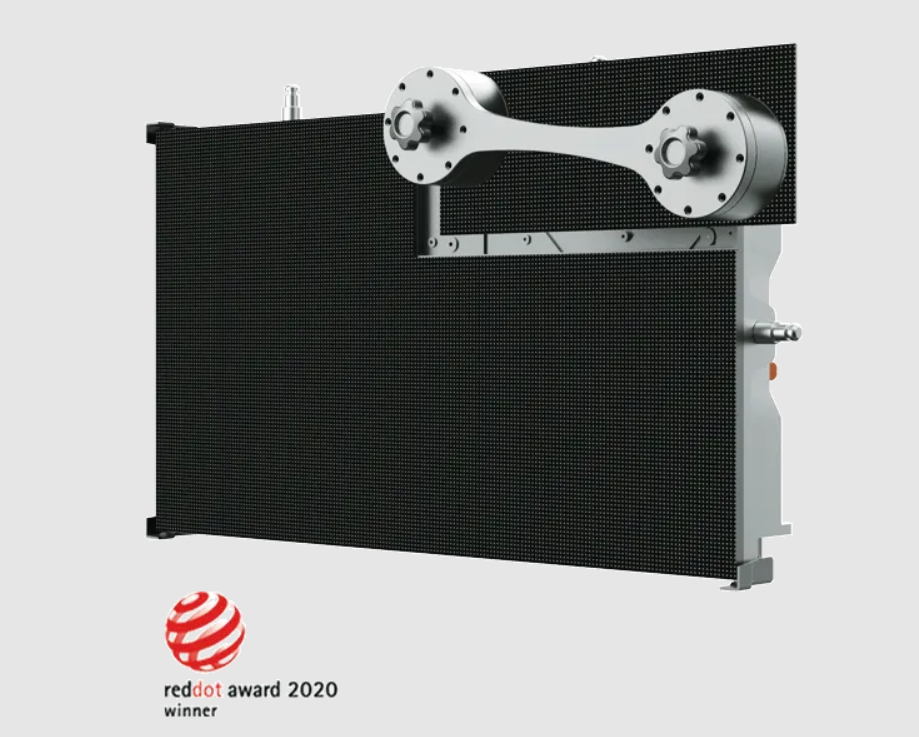
One major European broadcaster built two studios in Berlin for a major football championship coverage. They used fine pitch LED panels with a custom sliding mechanism. One studio sat on an outdoor terrace overlooking a famous landmark. The LED walls allowed the broadcast team to change graphics instantly, integrate augmented reality, and switch between multiple camera angles without missing a beat.
A national television network in Turkey installed a massive 5K by 2K direct view LED wall for their evening news program. The display measures 680cm by 225cm. That is huge. The anchor can walk freely around the studio while the background changes dynamically behind him. The near 180 degree viewing angle means the production team can compose shots creatively without losing image quality.
Virtual Production Is the Future Already Here
Virtual production takes the LED concept even further. Instead of just a background wall, you build an LED volume. That is a cube or a curved space made of LED panels on the walls, ceiling, and sometimes the floor. The talent stands inside this digital world. The camera tracks their position, and the background shifts in real time to match the perspective. It is like stepping into a video game.
This technology used to cost millions and only big Hollywood studios could afford it. Not anymore. Prices have come down significantly. Now regional broadcasters, corporate studios, and even educational institutions are building virtual production stages.
A major French television channel recently upgraded their broadcast studio with a curved 10.5 meter by 3 meter direct view led wall. They use a popular game engine to render extended reality sequences live during news and magazine programming. The display has a 1.95mm pixel pitch, proprietary technology to eliminate color shift, and enhanced durability for a 24 hour newsroom environment. The result is immersive, real time visual storytelling that keeps viewers engaged.
A leading studio in South Korea takes things to another level. It features a massive J shaped main LED wall up to 8 meters high and 60 meters wide, plus a height adjustable ceiling screen and mobile side walls. The direct view LED solution used there offers a 7680Hz refresh rate and 99 percent coverage of the DCI P3 color gamut. That kind of spec is what makes high end filmmaking possible inside a studio.
Why This Matters for Broadcasters
Let me be straight with you. A direct view led display costs more upfront than a green screen setup or an LCD video wall. That is just a fact. But the operational savings are real and immediate.
Post production time drops dramatically. You do not need to key out green spill or fix color mismatches. The image coming out of the camera is the final image. That means faster turnaround for daily news and live events.
Studio flexibility improves. The same LED wall can serve as a news backdrop in the morning, a talk show set in the afternoon, and a virtual sports studio at night. You just change the content. No physical set changes, no construction crews, no downtime.
Sustainability is another benefit. Virtual sets replace physical ones. No more building and trashing expensive studio sets every season. Less material waste, less transportation, lower carbon footprint. Some studies estimate that LED based virtual production can reduce greenhouse gas emissions by thousands of tons over the life of the studio.
Talent performance improves too. When the presenter can actually see the graphics they are talking about, the delivery feels more natural. They are not just staring at a green wall, imagining what the viewers see. They are inside the story.
Putting It All Together
Broadcasting is changing fast. Audiences expect more. They want immersive, dynamic, visually stunning content. A direct view led display gives broadcasters the tools to deliver that.
The technology has matured. Prices are more accessible than ever. And the benefits are clear. Better image quality, faster production workflows, lower operating costs, and greater creative freedom.
Whether you are running a local news station, a national sports network, or a corporate video studio, direct view LED is worth a serious look. It is not just a display. It is a production tool that changes how you create content. And once you start using it, you will wonder how you ever managed with green screens and LCD panels.

